By Jon Schweppe, Senior Advisor, American Principles Project
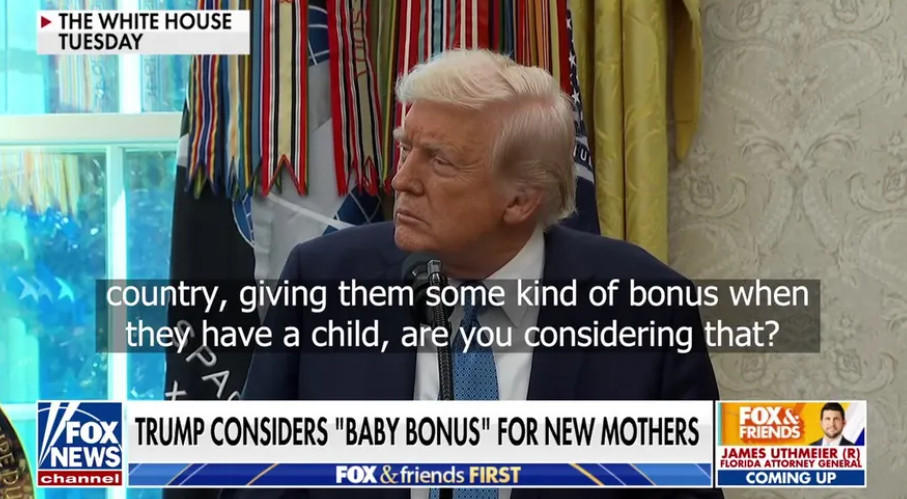
Early last year, a number of groups lobbied the White House and Congress for a “baby bonus” — a direct cash payment to parents of a newborn or adopted child. At the time, there was a lot of buzz about the idea possibly making its way into the One Big Beautiful Bill Act (OBBBA). President Trump even appeared to endorse one of the more generous proposals.
For whatever reason, the direct cash payment idea didn’t quite make it into the OBBBA.1 Instead, OBBBA included a different type of baby bonus: the Trump Accounts, a new type of tax-advantaged savings and investment account that functions like a traditional IRA for minors, with parents or guardians acting as custodians.
As part of the OBBBA, children born between 2025 and 2028 will receive $1,000 in seed money in their Trump Accounts. Families, friends, and employers can contribute up to $5,000 (combined) each year to the accounts. And additional philanthropic efforts will provide even more seed money for millions of children.2
I’m a big fan of the Trump Accounts. They serve as a brilliant way to help minors build wealth and set them up for adulthood. They’re almost like a mini-version of Social Security, but with parental custody and real ownership. They’re a wonderful idea, and they will be a lasting part of the President’s legacy.
But the Trump Account concept is a fundamentally different policy than a direct cash payment baby bonus. They solve different problems.
The affordability crisis is crushing new parents.
Between health care costs, basic care costs, and broader price pressures, new parents are feeling the squeeze like never before.
According to the most recent September 2025 analysis from the Peterson-KFF Health System Tracker, families with employer-sponsored insurance face an average of $2,743 in out-of-pocket costs for pregnancy, childbirth, and postpartum care alone. That money comes straight out of their pockets in the form of deductibles, copays, and coinsurance.
“[R]oughly one third of multi-person households and half of single-person households lack the liquid assets necessary to cover typical out-of-pocket costs associated with pregnancy and childbirth under private health plans,” Peterson-KFF asserts in its brief.
Add in newborn care, plus the everyday costs of diapers, formula, clothing, and lost wages during maternity leave, and the cost of parenthood in just that first year can become completely overwhelming.
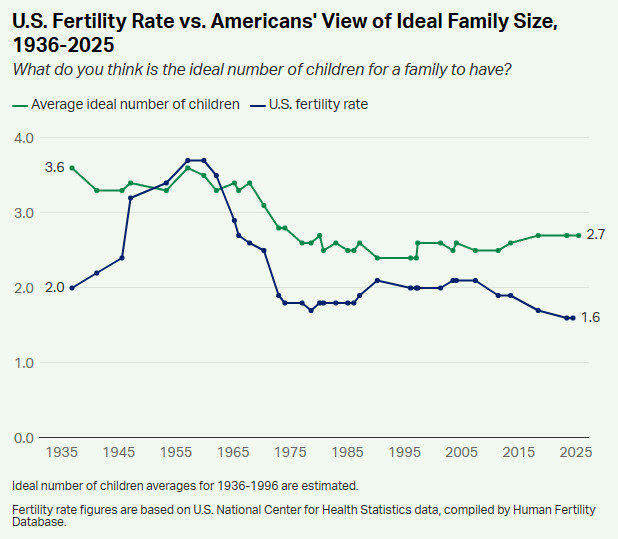
This is one reason why the U.S. birth rate continues to decline to historic lows, now down to just 1.6 children per woman. Yet, according to Gallup, Americans still say they want an average of 2.7 children.
Trump Accounts solve for a lot of problems, but they don’t really address this one.
So, what if we did both?
Trump Accounts set up children for the future. A baby bonus could help set up parents in the present.
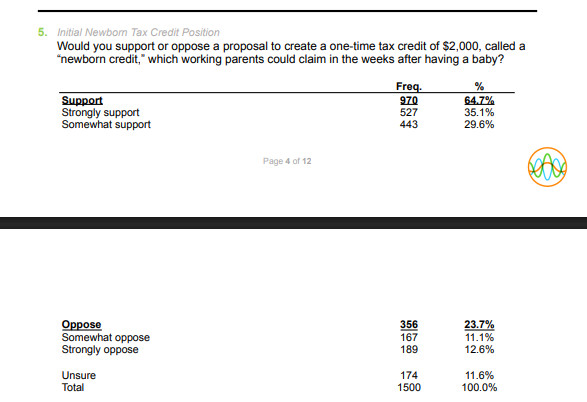
One of my favorite policy thinkers, Leah Libresco Sargeant, fleshed out her own baby bonus proposal in detail last year for the Niskanen Center. In it, she called for a $2,000 federal baby bonus to provide immediate financial relief to parents following the birth or adoption of a child.
Unlike traditional tax credits that have a delayed impact, the government would distribute the cash payment shortly after birth to help families navigate the sudden income shock and high initial costs of newborn essentials. With no phase-in or work requirements, Sargeant found that the total cost of the proposal would be merely $7.7 billion per year.3
A direct cash payment baby bonus like the one Sargeant proposes is likely to have an “income smoothing” effect for new mothers, as parents experience a substantial loss of income immediately following an infant birth. This can often be due to many mothers’ ineligibility for paid leave, which applies to as many as 30 percent of young parents. In this sense, a baby bonus can serve as a wage replacement, providing parents with a modest amount of the money they would otherwise earn to raise their children.
For those who don’t work, Sargeant argues that the baby bonus acts as a “floor for family benefits” that allows most if not all parents to take advantage. This stands in stark contrast to some of the contributory paid family leave programs being implemented in the states, which, in addition to being worker-restricted, scale with income. These are good programs. But a baby bonus would equally apply to all American families, no matter their employment status or income situation.
Obviously, a $2,000 baby bonus would be great, but the President previously endorsed a larger number. What if we did that instead? A $5,000 baby bonus, scaling Sargeant’s model and allowing for some positive birth-rate effects, would cost roughly $20 billion annually.
Providing meaningful support for new mothers is both pro-family and pro-life.
There’s obviously a very compelling economic argument for the $5,000 baby bonus. But isn’t it also a pro-life argument?
Sidewalk counselors and volunteers at crisis pregnancy centers hear the same story every day: economic insecurity ranks among the most common reasons women cite when considering abortion. The data also bears this out. And it can be challenging to convince these vulnerable women otherwise, especially if they lack a strong support system, which is all too often the case.
But a generous baby bonus could change the calculus by delivering immediate cash and a powerful message at the moment of greatest need: your community — churches, charities, family, friends, and even the federal government — stands ready to help. No questions asked. No strings attached.
The abortion industry would still go out of its way to convince women to choose abortion. But addressing this core financial pressure would help many expecting mothers to choose life.
Moreover, a baby bonus could pair well with Senator Katie Britt’s More Opportunities for Moms to Succeed (MOMS) Act introduced last year. While the MOMS Act creates a federal resource website offering information on prenatal care, adoption, foster care, and the risks of abortion, the baby bonus would establish a financial floor. Together, they would provide both practical resources and tangible support for expecting and new mothers.
Can this still be done in 2026?
I’m not a Senate rules expert. I rely on Rachel Bovard to tell me what’s possible regarding Senate procedure.
But recent precedent would suggest that baby bonuses could be enacted into law via the budget reconciliation process, the same expedited procedure Congress used in 2021 with the American Rescue Plan to deliver $1,400 direct cash payments to tens of millions of Americans, and more recently with the OBBBA to deliver the $1,000 federal seed money into every eligible newborn’s Trump Account.
Reconciliation is specifically designed for changes to mandatory spending and tax policy, allowing for new direct outlays like cash payments without the delays or 60-vote hurdles of the regular appropriations process. Just as the OBBBA directed the Treasury to issue those one-time $1,000 payments automatically upon birth certification and social security number issuance, a $5,000 baby bonus could be structured in the exact same way.
The question seems to be a matter of will, not whether it can be done. And it remains to be seen if that will exists in Congress. However, the President could reinvigorate the process by calling for a “Reconciliation 2.0” to accomplish some of the Administration’s top priorities prior to the midterm elections.
Passing a $5,000 baby bonus into law as part of that reconciliation package would deliver immediate relief to new parents while sending a clear message: America values families. Paired with the long-term vision of Trump Accounts, it would show voters that both President Trump and Republicans in Congress are serious about tackling the affordability crisis.
Originally published on Populist Solutions.