By Jon Schweppe, Senior Advisor, American Principles Project
Last month, the House of Representatives passed the “SAVE America Act,” a bill which would establish new federal requirements in elections, including documentary proof of citizenship in order to register to vote, and photo ID in order to cast a vote.
The bill passed the House, 218-213, with unanimous support from Republicans and support from one Democrat.
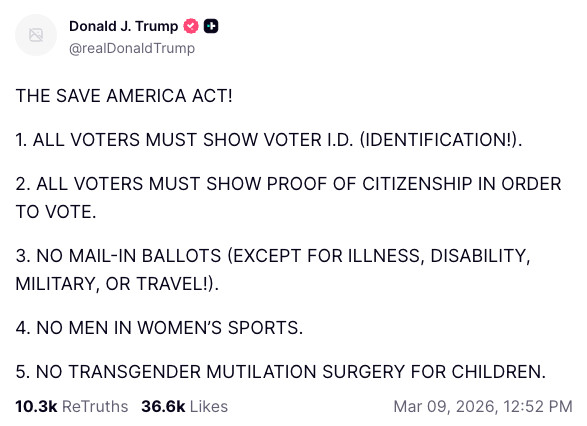
Soon after, President Trump doubled down on his support for the SAVE America Act and called for additional provisions to be included in the bill, including a ban on men in women’s sports and a ban on so-called “gender-affirming care” for minors:
Election integrity policies are very popular, as found in a poll by Heritage Action last month. Per The Daily Wire:
The survey, commissioned by Heritage Action, polled Republican, Democrat, and independent voters in Alaska, Georgia, Maine, Ohio, and North Carolina…
Sixty-nine percent of likely voters in Alaska and Georgia support “requiring proof of U.S. citizenship to register to vote in federal elections,” along with 71% in Ohio, 68% in North Carolina, and 65% in Maine, according to the poll.
When respondents were told the SAVE America Act would require proof of citizenship and a “valid ID” to vote in federal elections, support remained above 60% in all five states: 67% in North Carolina, 65% in Georgia, 64% in Alaska, 63% in Maine, and 62% in Ohio.
But despite election integrity’s popularity, the bill has faced an uncertain future in the Senate, where debate has stirred for weeks over how to handle the Democrats’ inevitable filibuster. For those who don’t know: the filibuster is a Senate procedure used by the minority to block or delay legislation. Typically, a 60-vote “supermajority” is needed to pass a “cloture” vote, which would end debate over the bill and allow the Senate to proceed to a final vote.
President Trump has repeatedly called on the Senate to embrace the so-called “nuclear option” by ditching the filibuster entirely, which would allow his agenda to pass through both chambers of Congress with ease. He argues that Democrats will absolutely do this the next time they control the House, the Senate, and the Presidency1.
Some conservatives, such as Sen. Mike Lee and others, have proposed a different workaround, one to which the President has also lent his endorsement: the “talking filibuster.” My friend, Rachel Bovard, Vice President of Programs at the Conservative Partnership Institute, explained this process in detail at The Federalist:
The Senate rules provide two ways to break a filibuster. The first is the mechanical way, by invoking cloture (the Senate’s term for ending debate), which requires 60 votes. The second, which has existed within the Senate’s rules since its inception, is by making senators talk — the “talking filibuster.”
The talking filibuster is a strategy that, first and foremost, imposes a physical and psychological cost of obstruction on filibustering senators. Second, it forces a public political process that has implications for those who oppose the bill. In other words, it doesn’t allow them to hide behind a single vote. If Democrats want to oppose securing the vote from the interference of noncitizens, they should have to explain why — at length and in public…
This strategy will take time. But withstanding a filibuster is limited by human factors: physical exhaustion, political exhaustion, and the nature of 100 people wanting to do other things. Both sides are forced into a negotiation at some point, if only because both of them want to make the pain end. This has a powerful, limiting effect on the length of a talking filibuster.
Although Senate Majority Leader John Thune resisted adopting this strategy in its entirety, he did go along with some of it. Now, the Senate prepares for a lengthy debate on the SAVE America Act. Democrats will have to hold the floor to delay the vote, while Republicans will get to set the agenda of the filibuster and call votes on Republican amendments. This will allow discussion about “gender-affirming care” for minors, for example, while forcing Democrats to defend their crazy ideas.
Chip Roy, the House sponsor of the SAVE America Act, wants to see the bill passed into law, but he still gave Senate Republican leadership credit for this strategy in an interview with The Daily Signal: “The fact that they’re going to put something on the floor, put amendments in queue … and then force some degree of focus and debate on this for some period of time is a step forward and I guess a victory in the sense that it means maybe we’ll have some debate and process here.”
And Bovard, who has been a stubborn thorn in Senate GOP Leadership’s side for months (years? decades?) similarly told The Daily Signal she was optimistic: “I think it’s great. The conservative movement has been asking for a robust deliberative process on this bill, and that is hopefully what we will get here… By just getting on the bill and not filing cloture immediately, the Senate floor will be more open than it has been in years.”
Finally, we will get Senate votes on 80/20 issues.
It’s not yet clear how this process will go. There are likely to be some surprises — that’s how the Senate should work. And while it’s extremely unlikely the SAVE America Act will pass in any form, it is still an enormous victory to get votes on these important issues.