By Jon Schweppe, Senior Advisor, American Principles Project
There was a serious effort last year, first in the One Big Beautiful Bill Act (OBBB) and later in the National Defense Authorization Act (NDAA), to pass an “AI moratorium” that would prohibit state-level AI regulation for 10 years.
The argument for the moratorium was fairly sound: we have a national interest in “winning” the AI race against China, we don’t want to hand control over AI to left-wing whack jobs in California, and even if California managed to curtail its crazy, a 50-state patchwork approach to regulating the AI industry would limit any innovation in the space by overwhelming upstart companies with burdensome compliance costs.
But there was a problem with the argument: the American people do want some regulation over the AI industry, especially when it comes to protecting kids, and they’re willing to say so. A recent OnMessage poll found that 81 percent of likely voters said they supported government guardrails over AI, while just 10 percent supported the idea that companies should innovate without restrictions.
Ultimately, the moratorium effort stalled last year, but the White House came up with a better solution that will satisfy stakeholders across the spectrum — and most importantly, satisfy the American people.
Don’t Call It a Moratorium. It’s One Big, Beautiful Federal Standard Now.
On Friday, the White House released its long anticipated “National Policy Framework for Artificial Intelligence.” The framework emphasized seven key pillars, which included:
Protecting Children and Empowering Parents
Safeguarding and Strengthening American Communities
Respecting Intellectual Property Rights and Supporting Creators
Preventing Censorship and Protecting Free Speech
Enabling Innovation and Ensuring American AI Dominance
Educating Americans and Developing an AI-Ready Workforce
Establishing a Federal Policy Framework, Preempting Cumbersome State AI Laws
Instead of pushing solely for a moratorium on state laws, the White House is now promoting a legislative package that establishes one big, beautiful federal standard for AI regulation, and most importantly, one that protects children and empowers parents.
From the framework:
I. Protecting Children and Empowering Parents
AI services and platforms must take measures to protect children, while empowering parents to control their children’s digital environment and upbringing.
Congress should build on actions to date by the Trump Administration to protect children, including the historic signing of the Take It Down Act, a key initiative of First Lady Melania Trump to protect children and adult victims from deepfake abuse.
Congress should empower parents and guardians with robust tools to manage their children’s privacy settings, screen time, content exposure, and account controls.
Congress should establish commercially reasonable, privacy protective, age assurance requirements (such as parental attestation) for AI platforms and services likely to be accessed by minors.
Congress should require AI platforms and services likely to be accessed by minors to implement features that reduce the risks of sexual exploitation and self-harm to minors.
Congress should affirm that existing child privacy protections apply to AI systems, including limits on data collection for model training and targeted advertising.
Congress should avoid setting ambiguous standards about permissible content, or open-ended liability, that could give rise to excessive litigation.
Congress should ensure that it does not preempt states from enforcing their own generally applicable laws protecting children, such as prohibitions on child sexual abuse material, even where such material is generated by AI.
This is a bold commitment to protecting kids online, and notably, it includes language suggesting that “Congress should establish commercially reasonable, privacy protective, age assurance requirements” — in other words, a federal age verification law. There might be some language in there one could quibble with, but that one won’t be me.
I tweeted support for the framework from an undisclosed vacation spot on Friday:
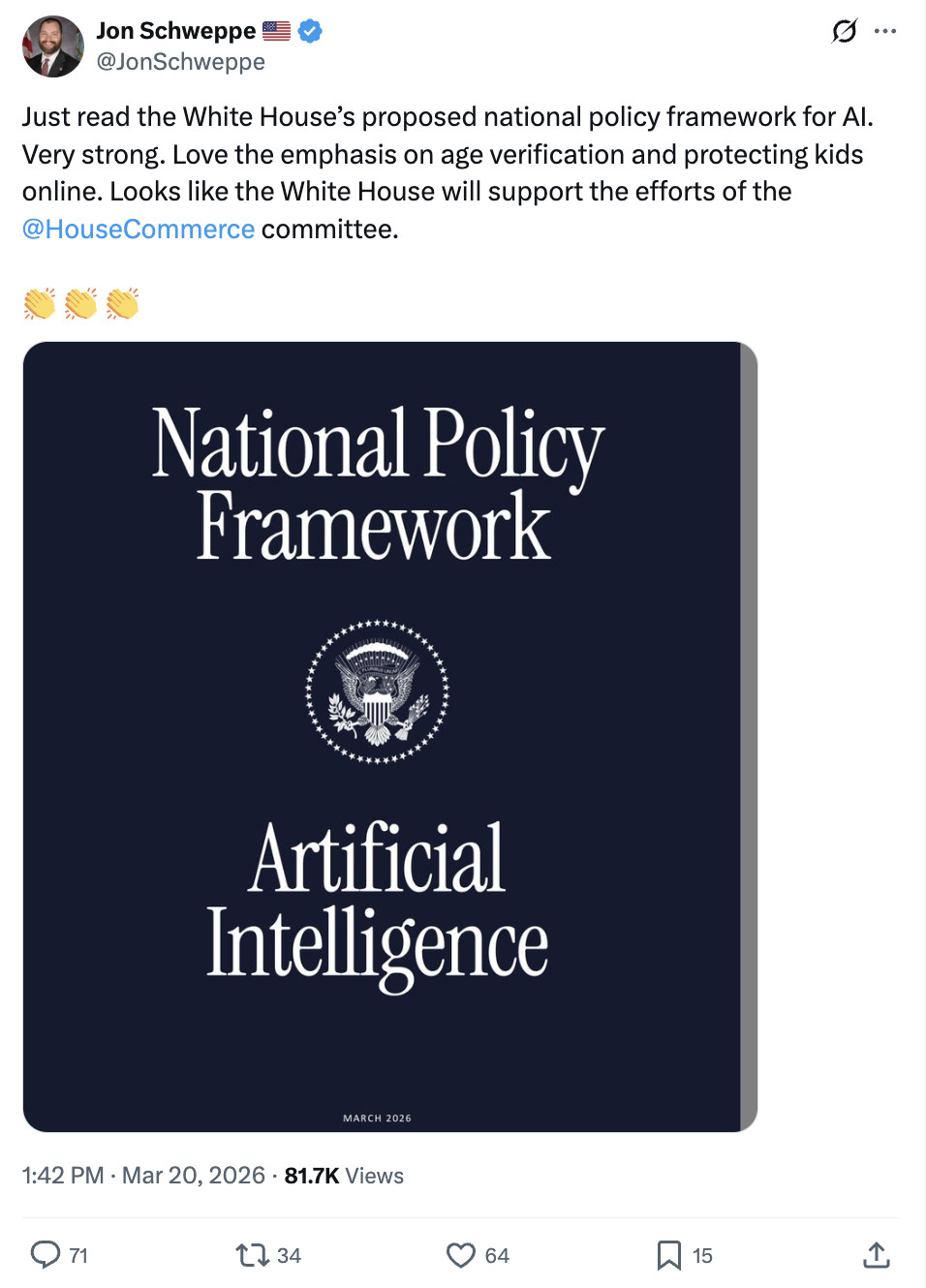
Notably, the tweet, which explicitly read support for age verification into the framework, was retweeted by Nathan Leamer, the executive director of Build American AI, and David Sacks, who serves as the White House AI and Crypto Czar.
So, here we are. Age verification is in. And we are a go.
Shuffle Up and Deal
Neil Chilson, the head of AI policy at the Abundance Institute, who I often disagree with but greatly respect as a fellow Federal Trade Commission alumnus, made an important point on Friday that I think merits consideration:
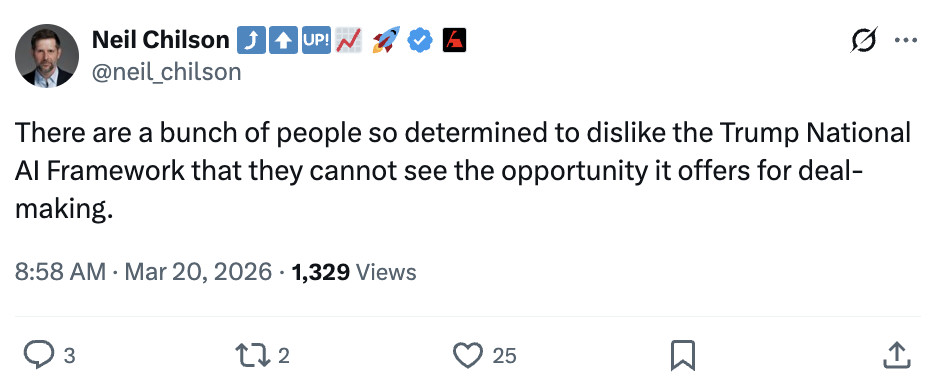
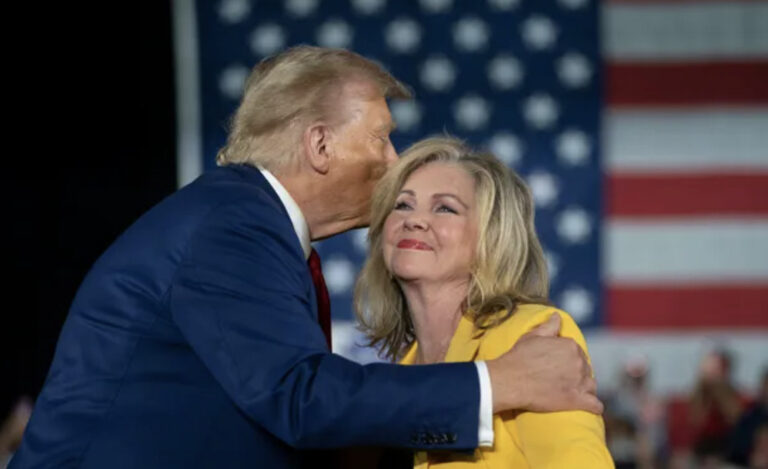
The actual substance of the bill resulting from the framework, which is being negotiated as we speak, remains up in the air. That’s why Sen. Marsha Blackburn (R-Tennessee), who was a key figuring in thwarting the AI moratorium effort last year, decided to get ahead of the White House and put out her own bill text, which she calls the Trump America AI Act.
Blackburn isn’t actually trying to pass her own framework. She’s a savvy politician who is loved and respected by President Trump (and vice versa). Notice she hasn’t criticized the White House’s framework at all. Instead, she’s working to incorporate her own provisions, including her Senate version of the Kids Online Safety Act, into the final legislative package.
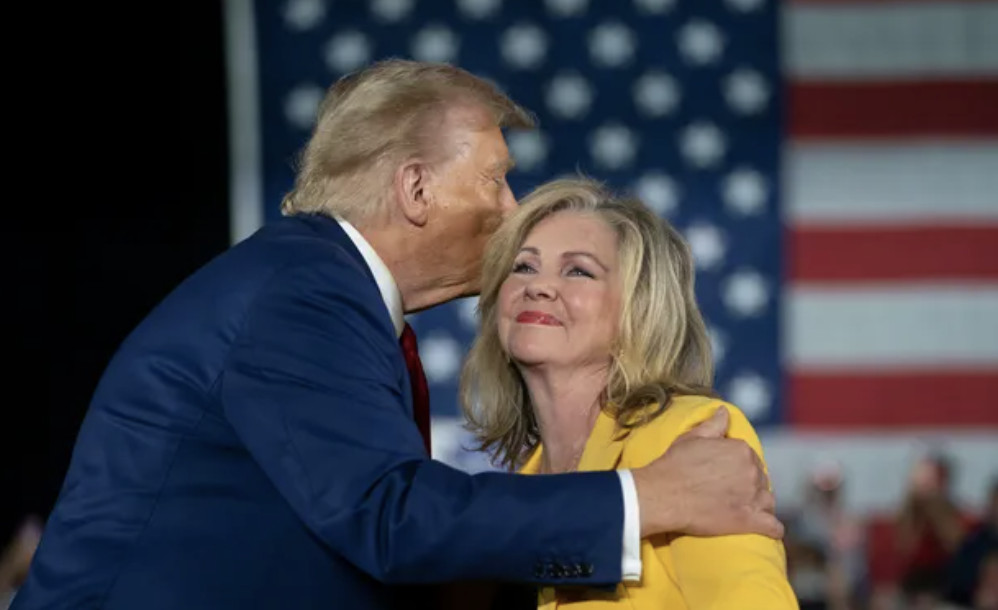
And that’s what we should all be doing. President Trump just provided us with a historic opportunity. If we pass this framework into law, and it includes age verification, we will do more this year to protect kids online and empower parents than we have done in more than a decade of policy work.
We just have to make deals.
As long as the framework includes provisions similar to what the House Energy & Commerce Committee recently passed: website-level age verification for adult content, via the SCREEN Act, and app store-level age verification, via the App Store Accountability Act, and some level of empowerment for parents and protection for kids when it comes to AI chatbots, the framework will continue to earn support from pro-family groups like American Principles Project (where I serve as a senior advisor.)
The good news: those provisions are an important selling point not only to pro-family groups but to the American people. According to a recent poll conducted by Cygnal:
81 percent of voters support the SCREEN Act
83 percent of voters support the App Store Accountability Act
Those numbers have held steady over time despite recent attacks on age verification from weirdos with anime avatars online. It remains one of the most popular, bipartisan policies one can accurately test with a poll. Including these bills in the final package is a no-brainer.
President Trump just set everyone up for a big win: innovators, communities, workers, and families.
Now, let’s finish the job and get it done!
Originally published on Populist Solutions.