
By Jon Schweppe, Senior Advisor, American Principles Project
This is an important week for protecting kids online.
The House Energy & Commerce Committee will hold a hearing tomorrow (Thursday) where it will consider a number of kids online safety bills that were forwarded through the Commerce, Manufacturing, and Trade Subcommittee in December.
Two of these bills are top priorities for us at American Principles Project: the SCREEN Act, an age verification bill that would require adult websites to verify all users’ ages so minors cannot access pornographic content, which is included within the Kids Internet and Digital Safety (KIDS) package, and the App Store Accountability Act (ASAA), a bill that would require app stores, such as Apple’s App Store and Google’s Play Store, to verify all users’ ages so minors cannot download apps without parental consent.
The SCREEN Act follows the lead of 25 states that have passed age verification for adult websites, while the App Store Accountability Act has passed in four states.
Age verification is popular.
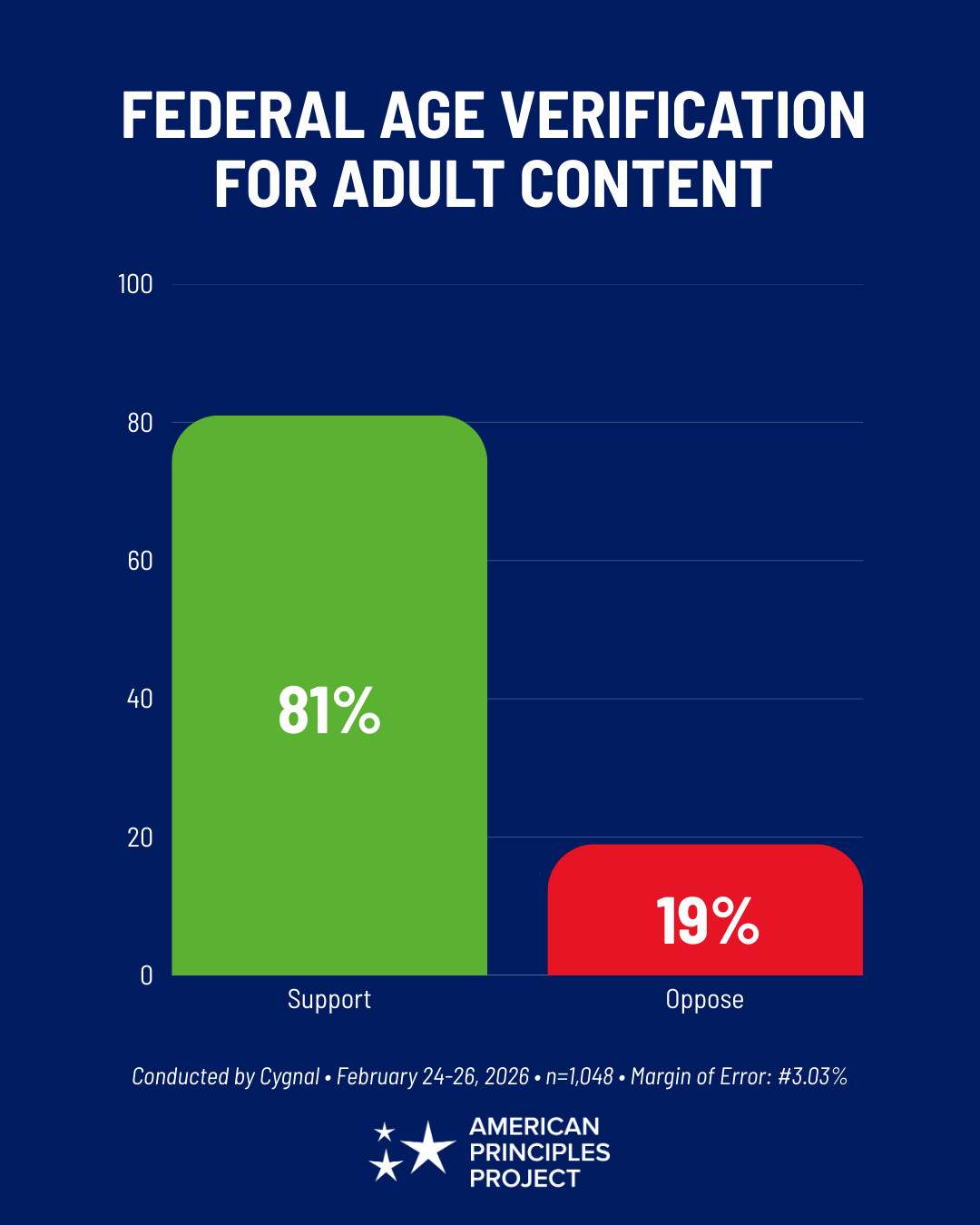
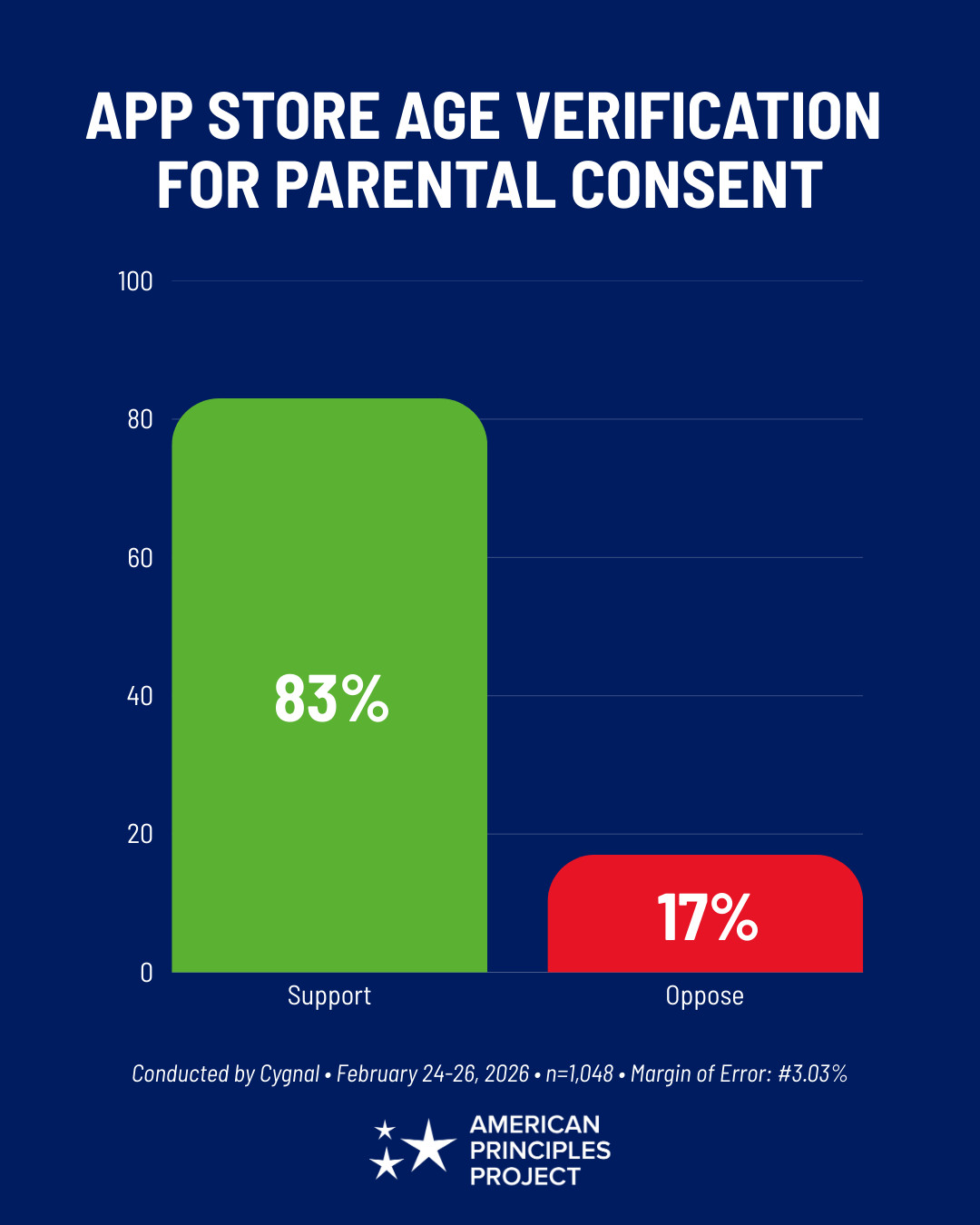
The SCREEN Act and the App Store Accountability Act certainly attract a few loud opponents — more on that later — but they are overwhelmingly popular with the American people. A new poll of likely general election voters conducted February 24-26 by Cygnal found stunning results:
“Would you support or oppose a federal law requiring adult websites to verify all users’ ages so minors cannot access pornographic content?”
“Would you support or oppose a federal law requiring app stores, such as Apple’s App Store and Google’s Play Store, to verify all users’ ages so minors cannot download apps without parental consent?”
More insights from Cygnal:
Pornography age verification is the strongest issue in the survey. 81% percent support it (66% strongly). That level of intensity is almost unheard of in modern polling. People genuinely care about keeping kids off these sites.
App store age verification is nearly as powerful and arguably more bipartisan. 83% percent support it (55% strongly) across Republicans (86%), Democrats (80%), and Independents (81%).
Among swing voters – the ones who decide elections – child safety measures net +68 in support. This isn’t a base-only play. The middle of the electorate wants this done.
Women support both age verification measures at 84%, men at 78-81%. The gender gap essentially disappears on child safety. You can message it to any audience without tailoring.
Incredible numbers. One of the strongest issues we’ve ever polled at American Principles Project.
Age verification is constitutional.
Tech lobbyists enjoy waxing poetic about the “unconstitutionality” of literally any tech regulation. They did this for years in regard to website-level age verification and just got handed the biggest of L’s at the Supreme Court in Free Speech Coalition v. Paxton. Scoreboard. But they’re still trotting out the same playbook this week, hoping a few uncurious Congresscritters might fall for a fake appeal to the Founding.
The SCREEN Act is constitutional. The bill text is very similar to the state age verification laws that have already passed constitutional muster. I doubt the porn industry even bothers to waste money on the legal fees.
The App Store Accountability Act is likely to face a constitutional challenge, and NetChoice is raring to go. But as I told State of the Net last month: unless a lawmaker is convicted that these types of bills explicitly violate the First Amendment, they should ignore what tech lobbyists and weird online activists have to say. Nobody knows how the Supreme Court will rule. The bill text is deliberately written in a content-neutral way as to avoid strict scrutiny. There’s a strong argument (made by people smarter than me) it is less likely to implicate the First Amendment and more likely to implicate precedents related to contract law and parental rights.
Age Verification is practical and privacy-preserving. It is not Digital ID.
I respect a good talking point, but the misinformation from Apple, Google, and their apparatchiks is totally out of control.
The state age verification laws were written in a way to ensure that any website that verifies age, or any third party that verifies age on a website’s behalf, is explicitly prohibited from retaining personal identifying information longer than necessary to complete the verification process. Both the SCREEN Act and the App Store Accountability Act include the same protections.
And that’s more than can be said for America’s current privacy regime, which amounts to a hodgepodge of loosely enforced laws in various subject areas: COPPA for kids’ data, HIPPA for health care, GLBA for financial disclosures, FERPA for education, FCRA for credit reporting, and more.
Many critics of age verification say they are worried about Digital ID. If you’re worried about Digital ID, you should talk to Congress about passing a bipartisan national privacy framework, as Rep. Cathy McMorris-Rodgers and Sen. Maria Cantwell tried to do a couple years back. My organization would be happy to endorse such an effort.
However, we already have Digital ID, at least how age verification critics describe it. Big Tech companies collect massive amounts of data on their users. That’s just a fact of life. That’s why they have enormous valuations. They have successfully monetized our data in creative and shocking ways.
But let’s just call a bad faith talking point a bad faith talking point. It needs to be said: many of the organizations criticizing age verification also go out of their way to criticize efforts to protect data privacy.
You’re really worried about a biometric when you’re opening your iPhone with a facial scan the second you step out of the shower?
You’re really afraid of companies using transactional data to estimate your age when they’re already using it to deliver you targeted ads?
Sorry, I just don’t buy it.
Congress should put parents and kids first — and leave Big Tech cronies to cry about it on Twitter. Pass the KIDS Act. Pass the App Store Accountability Act.
Originally published on Populist Solutions.