By Jon Schweppe, Senior Advisor, American Principles Project
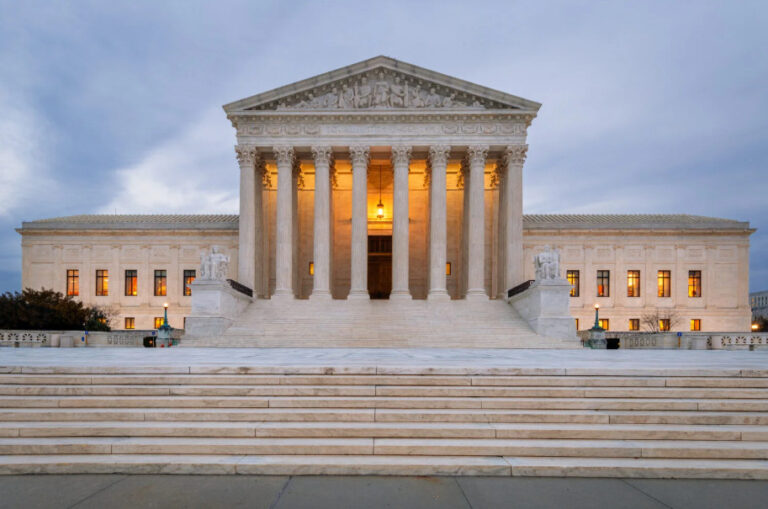
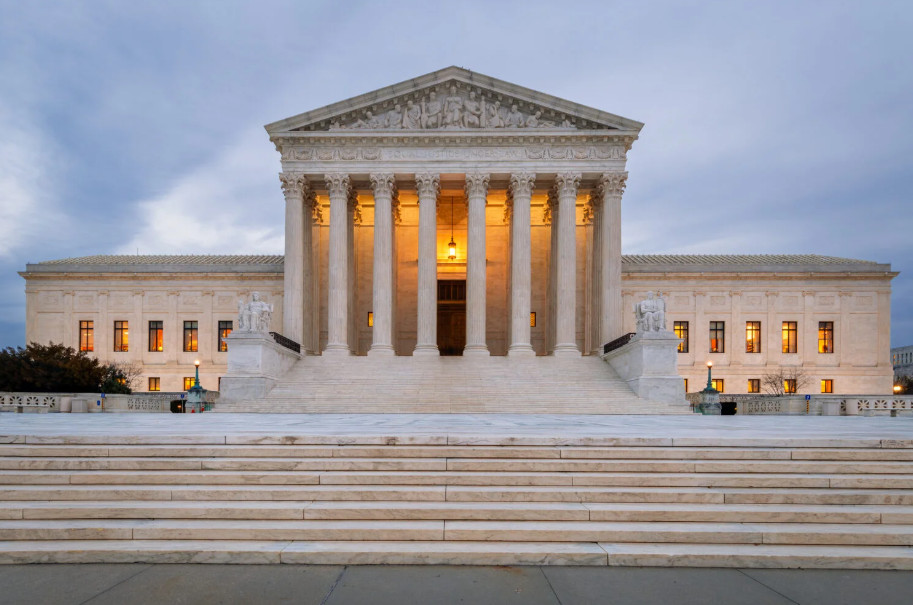
In February, the Supreme Court struck down President Trump’s “emergency power” tariffs, which he argued he could levy using executive authority granted by the International Emergency Economic Powers Act (IEEPA).
These tariffs included his “trafficking tariffs,” which the President levied against China, Canada, and Mexico for not doing enough to stop the flow of fentanyl into the United States, and his “reciprocal tariffs,” which were levied against nearly every nation for the “unusual and extraordinary threat” to our economy and national security posed by the nations’ various trade imbalances with the United States.
To the cheers of liberals, “true conservatives,” and moneyed interests, the Court ruled 6-3 that the IEEPA did not actually grant the President the authority to impose these tariffs. And with that, the President’s domestic agenda seemingly took quite the hit.
For many paleoconservatives, populists, and protectionists, the Court’s decision was demoralizing, but the plan-trusters never wavered. Indeed, the IEEPA was just one weapon in the President’s tariff arsenal. He still has a number of different options — good options — to defend American workers and strengthen American industry:
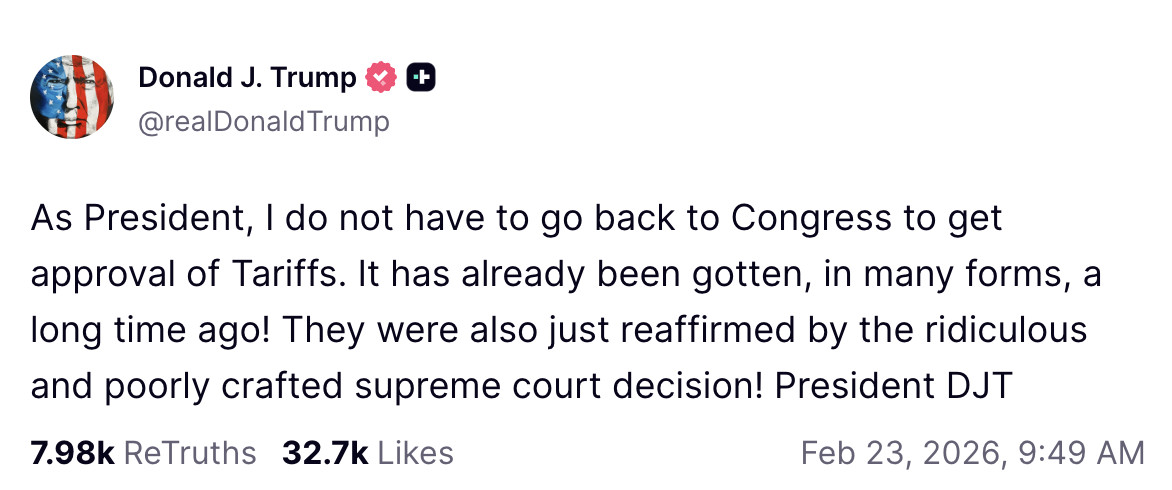
Immediately after the Supreme Court ruled, the President issued a proclamation imposing new tariffs. Specifically, he invoked his authority under Section 122 of the Trade Act, levying a temporary 150-day “ad valorem” 10 percent tariff on many goods imported to the United States.
He additionally promised further action on Section 232 of the Trade Expansion Act, which he has already used aggressively in both his first and second terms. Section 232 allows the President to respond when imports threaten national security. Unlike Section 122 tariffs, Section 232 tariffs do not necessarily expire and can be negotiated with trade partners.
The President also invoked his authority under Section 301 of the Trade Act, which allows the United States to respond to unfair foreign trade practices. As part of his proclamation, he directed U.S. Trade Representative Jamieson Greer to “investigate certain unreasonable and discriminatory acts, policies, and practices that burden or restrict U.S. commerce.” And other options, such as antidumping and countervailing duty laws, remain available when foreign governments distort markets.
Obviously, the President already has what he needs to act, and tariffs can and should remain a central instrument of American economic strategy.
But Congress should consider giving him an additional tool in his toolbox, a tariff that would revitalize American manufacturing and capitalize on one of America’s biggest advantages over the rest of the world: we’re the good guys, we play by the rules, and we don’t cheat.
INTRODUCING: Pollution Tariffs
In America, we take protecting the environment very seriously. We force our manufacturers to operate under environmental safeguards that carry real costs. Firms are required by law to install pollution controls, manage industrial waste streams, and comply with regulations to protect air, water, and surrounding communities.
This is a good thing. We should enjoy living in a clean country. I certainly do.
But many foreign competitors face no comparable obligations. As industry expands rapidly in countries like China and India, the environment rapidly deteriorates alongside. Factories discharge untreated waste into waterways, while belching black soot into the sky.
And this is a policy decision. Many of these governments simply have no regard for protecting the planet. They happily allow their industries to operate with minimal pollution controls and avoid compliance costs that American producers must bear. That’s their comparative advantage: China and India produce cheap, dirty products, and American producers struggle to compete.
The reality is that we are subsidizing this environmental disregard. We should stop doing it. Trade law exists to correct distortions created when foreign governments cheat, and that’s exactly what’s happening here. Polluting the environment, as a way to offload production costs as social costs onto the entire planet, is cheating. And we should hold cheaters accountable.
A pollution tariff would level the playing field. Imports entering the United States would face charges tied to the pollution intensity of their production. Goods produced in systems that ignore environmental safeguards would carry higher import fees at the U.S. border. American manufacturers would finally be able to compete on fairer terms rather than against imports benefiting from environmental shortcuts.
U.S. Trade Representative Greer has emphasized restoring fair competition for American industry and confronting distortions embedded in global supply chains. President Trump has framed the issue even more bluntly, warning that American jobs have migrated to what he calls “filthy pollution havens,” countries where companies slash costs by ignoring environmental safeguards required in the United States.
They’re both right. And a pollution tariff directly addresses the problem. By neutralizing the hidden subsidy created by environmental disregard, it gives American manufacturing a fighting chance.
The policy also offers strategic leverage that Washington now needs in trade negotiations, given how the administration relied on pressure from the President’s “emergency tariffs” (tied to IEEPA) as a central bargaining tool in talks with multiple trading partners. A number of countries entered negotiations with the expectation that those tariffs would remain the primary source of U.S. leverage.
The Court’s ruling unfortunately removes that leverage.
But a pollution tariff could replace it with something built on rock-solid legal footing. If access to the American market depended in part on safeguarding the environment, those countries would be heavily incentivized to raise standards.
That dynamic would force foreign competitors to bear the same compliance costs that American businesses already do. It would strengthen America’s hand in negotiations while encouraging improvements in environmental practices abroad.
No more cheating. No more punishing American manufacturers for being the good guys. Environmental disregard is a subsidy, and a pollution tariff would treat it like one.
Originally published on Populist Solutions.